
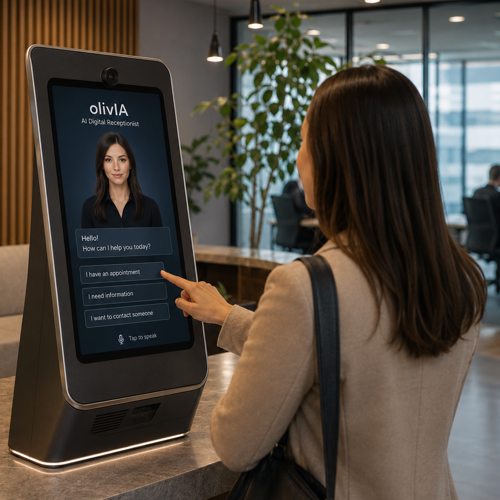
olivIA – AI-Enabled Workflow Transformation
olivIA is a KLP / KPWorld project focused on integrating AI solutions into real organisational processes. in:know supports the project through process analysis, workflow redesign, AI solution development and training. Rather than introducing AI as an isolated layer, the project analyses how work is performed and redesigns workflows so that AI tools can be embedded where they create value. One of these solutions is olivIA, a digital receptionist that supports user interaction, information access and front-office service processes.
Partners: KPWorld, in:know
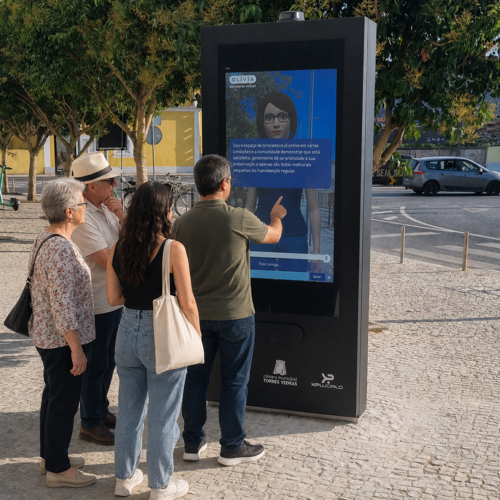
XRCity – Socially Acceptable XR Technology Demonstrator with Virtual Assistant for Cultural Engagement and Urban Development
XRCity is an innovation project exploring the use of extended reality and avatar-based interaction to support citizen participation in urban contexts. The project combined digital tools, participatory methods and decision-support approaches to make complex urban information more accessible and engaging for citizens. Within XRCity, in:know contributed particularly to the design of the interaction approach and to the analysis of social acceptance of the avatar as a communication and engagement interface. Website link.
Partners: in:know, KPWorld, C.M. Torres Vedras

MAGNET – Automatic Recommendation of In-Context Media Content to Support Exploratory Research in Journalism
MAGNET developed a software platform to support journalists in the early stages of article production. The platform analyses the topic and context of the story being developed and automatically recommends relevant older content from media archives. By combining topic identification, contextual similarity and collaborative filtering based on the activity of other journalists, MAGNET helps resurface useful background material at the right moment.
SW tool demo.
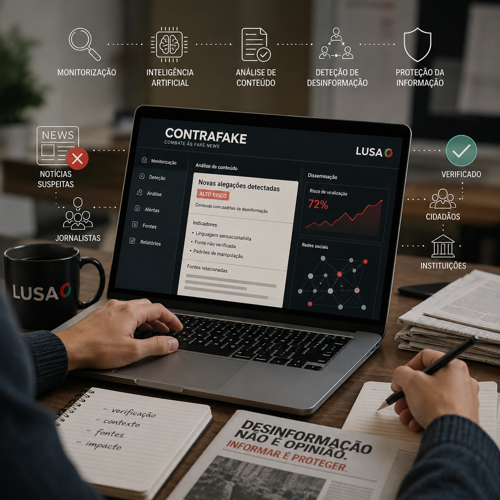
contraFake – Combating Fake News
CONTRAFAKE developed AI-based tools to support journalists, citizens and institutions in identifying and responding to false news and disinformation. Led by Agência LUSA (PT), with partners including INESC-ID, CNCS and in:know, the project explored computational resources for misinformation indicators, manipulation detection and early identification of viral disinformation processes.
Partners: LUSA, in:know, INESC-ID

Mezzanine — Workplace Productivity Tool Assessment
Mezzanine assessed SaaS productivity tools for a major international retail organisation, combining user interviews, usage data and structured feature-based comparison. The project supported the selection of a workplace productivity platform by mapping user needs, tool capabilities, integrations and adoption risks.
Partners: DG Solutions, in:know

SOKOBAN – Innovation in Ceramic Fixation Systems
SOKOBAN was an innovation project with Weber / Saint-Gobain focused on modular ceramic tile applications. in:know explored new ways to make ceramic surfaces easier to install, remove, replace and personalise, combining user interviews, empathy mapping, ideation and fast prototyping to identify practical concepts for future product development.
Partners: Weber / Saint-Gobain, in:know

ringo – Understanding ring formation in industrial lime kilns
Ringo project developed a physics-based simulation model of a real industrial lime kiln to better understand the conditions that lead to ring formation and kiln clogging. Using operational data from The Navigator Company, the project identified process variability, fuel-flow fluctuations and sulfur content as relevant contributors to temperature instability, recarbonation and ring formation. The resulting model supports predictive analysis, process optimisation and future digital-twin developments for improved kiln monitoring and control.
Partners: The Navigator Company, in:know
research group legacy projects

DIVERSITY – Cloud Manufacturing and Social Software Based Context Sensitive Product-Service Engineering Environment
DIVERSITY was a Horizon 2020 project focused on product-service engineering for globally distributed manufacturing enterprises. The project explored how cloud manufacturing, product lifecycle data and social software could support knowledge sharing and collaboration between the different actors involved in product-service design. Within DIVERSITY, the team contributed to the Decision Support System and Sentiment Analysis components. These tools supported the evaluation of product-service design alternatives and helped incorporate stakeholder feedback into the design process. The project reinforced the group’s experience in human-in-the-loop decision support, stakeholder-aware innovation and the use of qualitative feedback as part of engineering decision-making.
@Cordis: H2020-FoF-2015-636692
Partners: UNINOVA, ATB, UNIBergamo, UNIPatras, DESMA, CAREL, BAZIGOS, EKA, SLogic

EnPROVE – Energy consumption prediction with building usage measurements for software-based decision support
EnPROVE was a European research project focused on improving energy efficiency in buildings through decision-support methods and tools. The project addressed the problem of evaluating renovation and energy-efficiency measures not only through technical and economic criteria, but also through broader decision factors such as comfort, environmental impact, usability and stakeholder priorities. The project contributed to the group’s experience in multi-criteria decision support, human-in-the-loop assessment and the translation of complex technical information into usable recommendations for real decision contexts.
@Cordis: FP7-ICT-2009-248061
Partners: UNINOVA, PHILIPS, GEM, TECNALIA, CSTB, Active3D, UCD, MOSTOSTAL

LifeSaver – Context Sensitive Monitoring of Energy Consumption to Support Energy Savings and Emissions Trading in Industry
LifeSaver was a research project focused on decision support for improving energy performance and sustainability in buildings and industrial facilities. The project explored how technical, economic and environmental information could be combined to support better decisions about energy efficiency measures. The project contributed to the group’s experience in modelling complex operational contexts, evaluating alternative improvement scenarios and translating energy-related data into practical recommendations. It reinforced a line of work where decision support is not limited to technical optimisation, but also considers usability, implementation feasibility and the broader impact of decisions.
@Cordis: FP7-ICT-2011-287652
Partners: UNINOVA, ATB, JW Ostendorf, OAS, AMSeixal, SOLVERA, Alpacem Cement, IJS